
No products in the cart.
The $100 Handmade Knife Mistake Explained
At some point, almost every buyer considers a $100 handmade knife as a safe middle ground – not too cheap, not too expensive. It feels like a reasonable way to step into handmade knives without overspending.
“I don’t need anything fancy. I’ll get a handmade knife for around $100.”
It feels reasonable. Safe. Responsible.
After all, factory knives cost less. Handmade knives cost more. So $100 feels like a sensible middle ground – not cheap, not extravagant.
The problem is that a $100 handmade knife is often the most misleading option in the entire market.
Not because the maker is dishonest.
Not because the knife is useless.
But because something important had to be skipped to reach that price.
Why $100 Feels Like the ‘Safe’ Price
Psychologically, $100 sits in a comfort zone.
It’s:
- High enough to feel “serious.”
- Low enough to feel low-risk
- Easy to justify as an upgrade from factory knives
Online marketplaces reinforce this feeling. Scroll through Etsy or Instagram, and you’ll see hundreds of knives labeled handmade, custom, or artisan, clustered around the same number. When enough people price something similarly, it starts to feel normal.
But price clustering doesn’t reflect quality.
It reflects what the market tolerates, not what craftsmanship actually costs.
What a $100 Handmade Knife Usually Can’t Include
This is where the mistake happens. A knife can’t be inexpensive and fully considered at every stage.
At that price point, compromises are unavoidable.
Skilled Labor Time
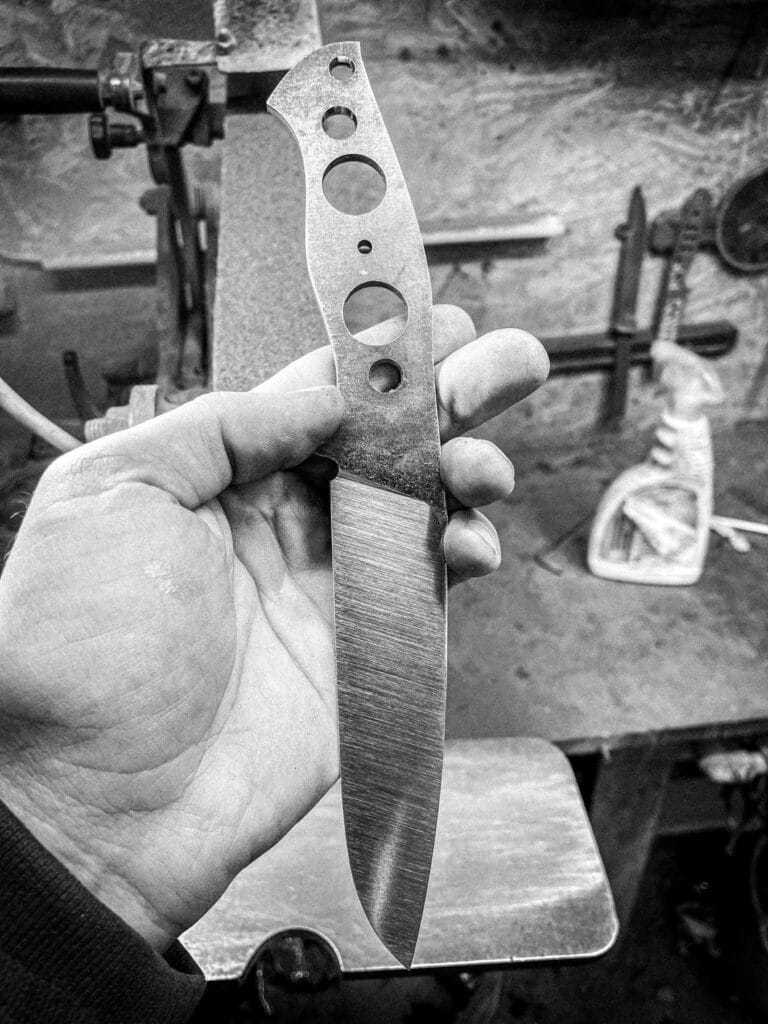
A genuine handmade knife takes hours of focused work – shaping, grinding, heat treatment decisions, fitting, finishing, and testing. At $100, the math doesn’t work unless that time is dramatically reduced.
That usually means:
- Pre-cut blade blanks
- Minimal refinement
- Speed over precision
The knife may look finished, but it wasn’t thought through.
Controlled Heat Treatment
Heat treatment is one of the most critical – and most expensive – parts of knife making.
Done properly, it requires:
- Controlled temperatures
- Specific cycles
- Adjustment based on blade geometry and intended use
At lower prices, heat treatment is often outsourced in bulk or treated as a checkbox rather than a tuning step. The result is a blade that may be hard, but not appropriate for how it’s meant to be used.
This isn’t visible at first. It shows up later.
Purpose-Driven Design
Cheap handmade knives often try to be everything at once.
They’re marketed as:
- EDC
- Outdoor
- Survival
- Camp
- Kitchen-capable
That versatility sounds appealing, but it usually signals a lack of focus. When a knife isn’t designed around a clear job, it ends up being average at all of them.
Purpose costs time. And time costs money.
Where the Cost Comes Back to Bite You
The problem with a $100 handmade knife isn’t immediate failure.
It’s quiet disappointment.
Over time, buyers notice:
- The edge doesn’t hold as expected
- The blade chips or rolls unexpectedly
- The handle becomes uncomfortable during longer use
- Confidence in the tool fades
The knife still works – technically. But it stops being trusted. And once a knife loses trust, it gets replaced.
That’s how a “budget” knife becomes expensive.
When a $100 Knife Actually Makes Sense
This is important – because honesty builds trust.
A $100 knife can be perfectly reasonable when:
- You need a beater or backup
- The knife is for learning or experimentation
- It’s a loaner or secondary tool
- Performance expectations are modest
There’s nothing wrong with that.
The mistake happens when buyers expect long-term performance, consistency, and refinement at a price that can’t support them.
What You’re Really Paying For in a $250–$400 Handmade Knife
When you move beyond the $100 range, the change isn’t just materials – it’s decision-making.
At higher price points, you’re paying for:
- Time spent refining geometry
- Heat treatment tuned for use, not averages
- Handles shaped for real hands, not photos
- Accountability from a maker who stands behind the knife
This doesn’t guarantee perfection. But it dramatically reduces compromise.
A knife in this range is usually designed to do one job very well – and to do it repeatedly without surprises.
The Real Question Isn’t Price – It’s Expectations
A cheap handmade knife isn’t automatically bad.
It’s only expensive when you expect it to perform like something it isn’t.
If you want:
- Predictable cutting
- Edge stability
- Comfort over time
- Confidence in use
…then price stops being about money and starts being about fit.
How to Avoid This Mistake Completely
The simplest way to avoid the $100 knife mistake isn’t spending more blindly.
It’s learning how to recognize when a knife was designed intentionally – and when it was assembled to meet a price point.
That’s exactly what we break down in 5 Signs of a Genuine Handmade Knife (And How to Spot a Fake). Understanding those signs makes price comparisons far clearer – and far less frustrating.
Why Knifia Doesn’t Compete in Price
Knifia isn’t built for impulse buying.
It’s built for people who want to understand what they’re paying for – and why.
That means the knives you’ll find here aren’t the cheapest. But they are chosen because their design, heat treatment, and purpose justify their cost in real use, not just on a screen.
If a $100 knife fits your needs, that’s a valid choice.
If you expect more, it helps to know what more actually costs.
Your Fixed Blade collection on Knifia.com
Related posts

Quick Answer: Is a Handmade Knife a Good Gift? A handmade knife can be an excellent gift... Continue reading
Most “best knife” lists miss the point There’s a problem with most of the best handmade EDC... Continue reading
At some point, every serious home cook hits the same fork in the road. This guide breaks... Continue reading
The modern chef knife is often treated as the one tool every home cook must own –... Continue reading
The phrase “handmade knife” is everywhere today – on Etsy listings, Instagram ads, and product pages selling... Continue reading